
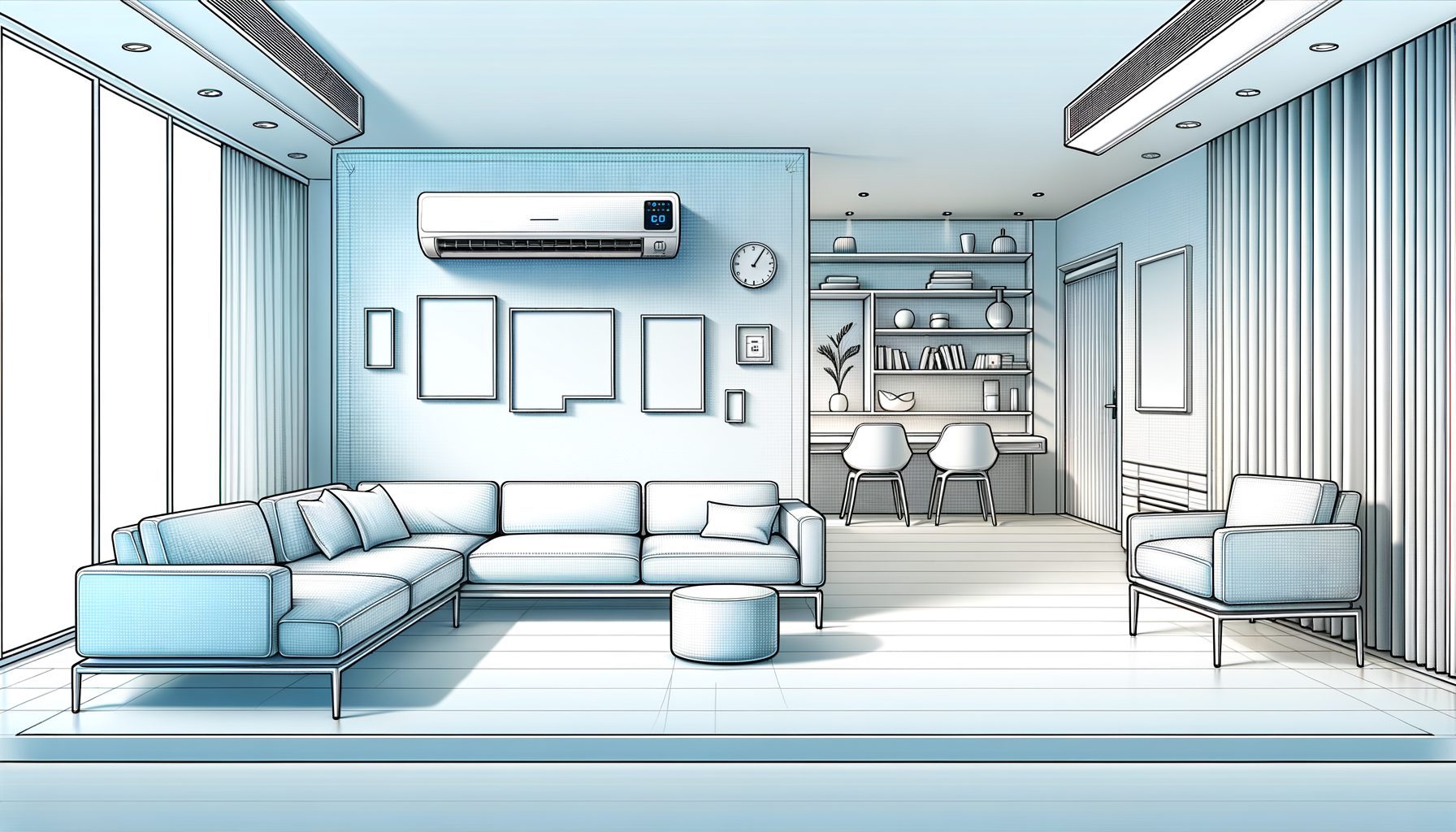
Care about clean lines, calm vibes, and lower bills? Then AC placement can make or break the room. Smart Air Conditioner Placement for Minimalist Room Design isn’t about splurging on hardware; it’s about positioning so the space cools evenly, stays uncluttered, and runs efficiently. Many people end up with a cold blast aimed at the wrong spot, stubborn hot corners, and a wall unit that hijacks the view. The good news is simple: make a few precise choices and you’ll land comfort, aesthetics, and savings together.
The real problem: bad AC placement ruins comfort and minimalism
Uneven cooling, sun glare warming the unit’s sensor, noisy vibration, and condensate streaks—small minimalist rooms see them all. Most of those headaches trace back to a single choice: where the air conditioner sits. Park the indoor unit opposite a sun-blasted window and the thermostat “believes” the room is hotter than it is; hide it behind a tall bookcase and airflow gets strangled; mount it too low and you’ll get a face-level blast while the ceiling stays hot. At the same time, the visual noise of exposed pipes and crooked trunking can unravel the minimalist vibe.
Comfort problems aren’t just vibes. Energy Star notes that improper HVAC installation can slash efficiency by up to 30%. That lost efficiency shows up as longer run times, higher utility bills, and faster wear on parts. In studios and bedrooms, a misplaced unit creates “microclimates”—cold zones near the jet and warm zones farther away. As a result, people drop the setpoint lower than necessary, which wastes even more energy.
Minimalist design adds another layer: negative space, symmetry, quiet surfaces. A wall unit hung awkwardly can dominate a small room, pull the eye, and fight the clean geometry of shelves, doors, and lighting. The fix isn’t complex, yet it is specific. Match throw distance to room length, steer clear of thermal traps, keep clearances generous, and route lines neatly. Get those fundamentals right and you’ll enjoy even cooling at a moderate setpoint, lower noise, and a unit that visually recedes into the plan.
Measure, size, and map airflow before you mount
Map the room before anyone drills a hole. Measure width, length, and ceiling height. Note obstacles (wardrobes, tall shelves, curtains), heat sources (south-facing windows, electronics), and where people sit or sleep. The aim is simple: pick a spot where supply air can travel the room’s longest dimension without slamming into large obstacles, then loop back naturally to the unit.
Next comes capacity. As a quick baseline, plan around 20 BTU per square foot (about 65 W per square meter) for typical rooms, then adjust: add roughly 10% for strong sun exposure, add 600–800 BTU/h for each regular occupant beyond two, and go higher for kitchens. Oversizing tempts many, yet it risks short cycling that raises humidity and cuts comfort. When uncertain, get a professional load calculation (Manual J) or lean on official guidance like the U.S. Department of Energy’s room AC tips. Well, here it is: right size first, or everything downstream gets harder.
Clearances matter. For most wall-mounted splits, 10–15 cm (4–6 in) of space above, 12–15 cm (5–6 in) on each side, and at least 1–1.5 m (3–5 ft) of open space in front are recommended so air can be thrown effectively. Typical “throw” distances for compact units range from 4 to 8 meters (13–26 ft), depending on model and fan speed. Always check your model’s manual; manufacturer rules override generic advice.
Then this quick reference helps align room size, capacity, and placement basics.
| Room area | Suggested capacity | Ideal wall-mount height | Top clearance | Side clearance | Typical throw range |
|---|---|---|---|---|---|
| 10–15 m² (100–160 ft²) | 6,000–9,000 BTU/h (1.8–2.6 kW) | 2.1–2.3 m (7.0–7.5 ft) from floor | 10–15 cm (4–6 in) | 12–15 cm (5–6 in) | 4–6 m (13–20 ft) |
| 16–25 m² (170–270 ft²) | 9,000–12,000 BTU/h (2.6–3.5 kW) | 2.1–2.3 m (7.0–7.5 ft) from floor | 10–15 cm (4–6 in) | 12–15 cm (5–6 in) | 5–7 m (16–23 ft) |
| 26–35 m² (280–375 ft²) | 12,000–18,000 BTU/h (3.5–5.3 kW) | 2.1–2.3 m (7.0–7.5 ft) from floor | 10–20 cm (4–8 in) | 15–20 cm (6–8 in) | 6–8 m (20–26 ft) |
Finally, sketch airflow. Aim the louver so the jet tracks the room’s long axis, not directly at a bed or sofa. Avoid mounting above heat sources or right opposite strong sun without shading. If the only viable wall faces a bed, angle vanes upward to mix air along the ceiling first. Spend a few minutes on mapping and you’ll prevent years of discomfort.
Aesthetic integration strategies that keep minimalism intact
Minimalist rooms succeed because every line is intentional. Treat the AC the same way. First, align the indoor unit with a dominant datum in the room: the top line of a door frame, the upper shelf of a built-in, or a picture rail. Doing so creates visual continuity, so the unit reads as part of the architecture rather than a bolt-on box. When possible, center the unit on a wall segment—not the entire room—to avoid fighting asymmetrical doors or windows.
Next, conceal the “visual noise.” Use color-matched trunking or paintable conduit covers, keep line-sets level, and minimize exposed bends. If the line-set must cross a feature wall, tuck it along a shadow gap or ceiling junction where the eye expects a joint. Many installers favor the shortest drain path; push for the cleanest path instead. A 1–2% downward slope is sufficient for gravity drainage, and neat routing pays off daily.
Choose a unit with a low profile and quiet operation. For bedrooms, target indoor noise ratings around 19–24 dB(A) at low fan; for living rooms, under 30 dB(A) feels calm. Neutral finishes (matte white or soft gray) blend into most minimalist palettes. If budget allows and a false ceiling exists, ceiling cassettes or slim ducted units can all but disappear—only a linear grille remains. In tight studios, floor-mounted consoles can slip beneath a window bench, preserving wall real estate for art.
Think about how people move. Don’t place the unit where it blocks a focal point such as a TV wall or art piece. Instead, nudge it toward a side wall so it “vanishes” in peripheral vision. For very small rooms, consider positioning above the door; often, that choice aligns with existing trim lines and keeps the main wall clean. Plan for service access, too: minimalist doesn’t mean inaccessible. Leave clearance for filter removal and coil cleaning without dismantling millwork.
Installation, safety, and smart control practices for efficient comfort
Placement only works when the installation supports it. Keep the indoor unit high on the wall (about 2.1–2.3 m or 7–7.5 ft from the floor) so cool air can mix from the ceiling down. Manufacturer clearances should be maintained—commonly 10–15 cm above and 12–15 cm on the sides—with at least 1 m of open space in front. Dead corners and heavy curtains are to be avoided. For drainage, maintain a continuous 1–2% fall to a safe outlet; use a condensate pump only when gravity won’t work, and include a service loop for maintenance.
Outdoor units need breathing room and vibration control. Provide at least 30 cm (12 in) behind and around the condenser (or follow the manual), mount on a solid bracket or pad with anti-vibration feet, and don’t box it in. Shade can help, but airflow must not be blocked. In apartments, keep sound off shared walls and away from bedrooms when possible. UV-resistant covers should be used on line-sets exposed to sun, and routing should minimize water ingress.
Smart controls are the final multiplier. What’s interesting too is how much geofencing helps: Wi‑Fi adapters or smart AC controllers can trim runtime by cooling only when you’re close to home. Set a moderate target—24–26°C (75–79°F) suits most climates for comfort and efficiency. Follow U.S. Department of Energy guidance and raise setpoints when away; even 1–2°C higher can save energy, and longer setbacks can deliver around 10% annual HVAC savings. Use schedules for sleep and work hours, and enable quiet or “night” modes to tame noise peaks.
Maintenance locks in performance. Clean filters monthly during heavy use, wash or replace per the manual, and have coils inspected annually. A dirty filter reduces airflow, forces higher fan speeds, and nudges your power bill upward. If the room smells musty, check the drain trap; standing water often causes odors. To keep the minimalist look over time, review line-set covers annually for discoloration and touch up paint as needed. Small upkeep, big payoff.
Q&A: quick answers to common placement questions
Q: What is the best height for a wall-mounted split in a small room?
A: Mount it high so cool air can spread along the ceiling first—typically 2.1–2.3 m (7–7.5 ft) from the floor—with 10–15 cm (4–6 in) of free space above. Always defer to your model’s manual for exact clearances.
Q: Can I place the indoor unit above a bed or sofa?
A: You can, but avoid direct airflow on people. If that wall is the only option, angle the vanes upward and use a wide swing. Many prefer a side wall that throws air across the room rather than at seating or the headboard.
Q: Is it okay to put the AC above a window or door?
A: Above a door can work if clearances are met and the line-set can exit cleanly. Above a window is trickier due to heat and limited structure; ensure solid framing, no direct sun on the thermostat sensor, and proper support.
Q: How do I reduce outdoor unit noise on a balcony?
A: Install anti-vibration pads, keep at least 30 cm (12 in) of clearance around the unit, avoid thin metal rails for mounting, and prevent the fan from echoing inside a tight alcove. Clean the coil regularly and confirm the unit is level; an out-of-level fan hums louder.
Conclusion and next steps
Bottom line: comfort, clean aesthetics, and low energy bills start with smart placement. You’ve seen why bad locations waste power and break the minimalist look; how to measure, size, and map airflow so cool air reaches every corner; how to integrate the unit with strong visual lines and quiet finishes; and how correct installation, drainage, outdoor spacing, and smart controls lock in performance. None of these moves are complicated on their own, yet together they transform daily living in a small, minimalist room.
Next steps are straightforward. Spend five minutes measuring the room and sketching airflow along the longest dimension. Mark two or three candidate wall spots that maintain clearances and keep the unit out of your main sightline. Check your model’s installation manual for exact distances. Then talk to a licensed installer with your sketch in hand and insist on neat, color-matched routing for line-sets and drains. Finally, set up schedules or geofencing on a smart controller so the AC works around your life, not the other way around.
If you want a space that feels cool, looks calm, and costs less to run, start with placement. Make one precise decision now and enjoy years of quiet comfort and minimalist clarity. Ready to map your room tonight and circle the best spot on the wall? Your future self—chilling in a perfectly balanced space—will thank you.
Helpful outbound resources:
• Energy Star HVAC guidance: https://www.energystar.gov/campaign/heating_cooling
• U.S. DOE Energy Saver, room air conditioners: https://www.energy.gov/energysaver/room-air-conditioners
• ASHRAE thermal comfort resources (Standard 55): https://www.ashrae.org/technical-resources/standards-and-guidelines
• Energy Star smart thermostats overview: https://www.energystar.gov/products/smart_thermostats
Sources
• Energy Star, Heating & Cooling Campaign: improper installation impact and efficiency best practices.
• U.S. Department of Energy, Energy Saver: guidance on room AC sizing, placement, and thermostat setpoints.
• Manufacturer installation manuals (e.g., Mitsubishi Electric, Daikin): clearance and mounting requirements.
• ASHRAE Standard 55: fundamentals of thermal comfort and air distribution considerations.